
Date Wilmington Resident Records by Source
Choose the first source by the period being tested. The Registry holds very deep land images, but its computerized search is much newer. Library material can preserve household or name references, yet it does not prove ownership. State and federal census collections add household context only for their own enumeration dates. The most reliable result is a dated chain that states whether a name is an owner, occupant, official, relative, or historical mention.
| Source | Years it covers | Where held | What it can show |
|---|---|---|---|
| Middlesex North recorded land images | 1629 to present | Middlesex North Registry | Recorded parties, deeds, plans, book/page references, and legal descriptions |
| Registry computerized name route | 1976 to present in the instructions | Masslandrecords | Party, town, date, document type, and book/page or registration reference |
| Unindexed Registry book images | 1855 through December 1949 | Registry books 1 through 1131 | Earlier recorded instruments reached through scans and book/page clues |
| Wilmington directory holdings | 1919 and 1931-1932 | State Library inventory | Printed historical directory entries when the item can be consulted |
| Town reports and persons-listed material | 1829 through 2022 for displayed reports | Wilmington Memorial Library | Dated names, town roles, road references, and selected local material |
| Census and archival series | Federal 1790-1950; Massachusetts 1855 and 1865 | Massachusetts Archives resources | Household and historical context where the relevant series is available |
The 1919 and 1931-1932 directory holdings are collection locators, not proof that a page image is available online. Ask the State Library whether a volume is digitized, available onsite, or obtainable by reproduction before citing an entry.
Start Wilmington Resident Records at a Parcel
Begin at the Wilmington Online Assessment Database with the current house number and street spelling. Vision offers address, owner/name, and parcel or property paths. Record the parcel ID, situs address, assessed owner, map, fiscal year, and any visible sale data. The site was observed as FY26 with values based on the January 1, 2025 assessment date. That field identifies an assessed owner for that tax year, not a current occupant or a past household.
Next, compare the parcel geometry in MassMapper. The map provides property-tax parcels, buildings, municipal boundaries, and other layers. A parcel can be divided, combined, or described by a lot number in older records. Save the map context, but use the Registry deed and plan references to establish the legal trail.
Trace Wilmington Resident Records Through Deeds
The Middlesex North Registry index is the backbone for past owners of a Wilmington parcel. Search the assessed owner and town, use plausible spelling variants, and inspect the deed itself. The Registry’s search instructions describe a last-name and first-name route, Advanced filters for document type, town, and date, and property searching by street number and name. When property searching, omit Street, Road, or Avenue as instructed and test ordinal or hyphen variations when needed.
- Capture the current parcel’s assessed owner, situs, parcel ID, fiscal year, and any visible sale context in Vision.
- Find the recent recorded deed in Middlesex North. Record the grantor, grantee, recording date, document type, book/page or registration reference, legal description, plan citation, and any prior-title reference.
- Use the prior reference to locate the earlier conveyance. The earlier grantee is often the party who acquired the parcel before the later transfer.
- Repeat the document-to-document check, preserving each link even when an address is absent. A lot, plan, abutter, or legal description may be the only bridge.
- If the chain breaks at inheritance, consult Middlesex Probate and Family Court North records through the court route. Probate files are not recorded as Registry deeds.
The Registry instructions show the modes and limits that govern that backward search.
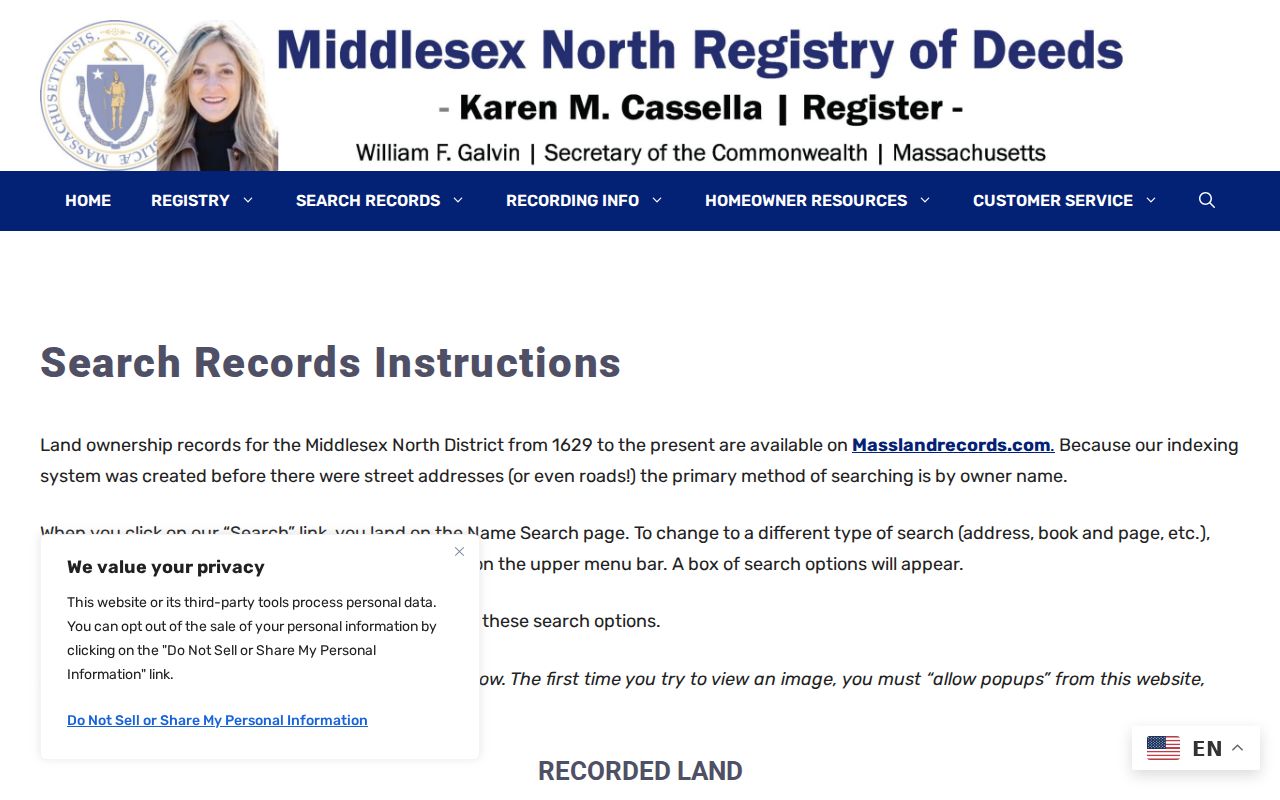
The image route matters because an index line is only a pointer. Open the document image before relying on a party name or a short property description.
Browse Wilmington’s Earlier Resident Records
The Registry’s scanned coverage reaches back to 1629, but historical research changes form as the chain becomes older. The search-instructions page describes a computerized name index from 1976 forward, while a separate Registry statement says computer indexes run from 1966. Rather than blend those statements into one cutoff, treat 1976 as the reliable indexed-name starting point and route earlier work through the grantor/grantee scans. Books 1 through 1131, covering 1855 through December 1949, are unindexed images; book search begins at book 1132 in January 1950.
For an earlier name, select the appropriate pre-1976 date range, then search the scanned grantor or grantee index. A returned name may be only the first name on an index page, so inspect neighboring pages. Copy the book, page, date range, spelling, and any plan or abutter wording before moving to the deed image. This is slower than a modern address search, but it is the documented route for many Wilmington past-resident questions.
The Middlesex North search screen provides the entry points for names, property, dates, book/page, and historical index work.
Record the recording date and instrument location even when the document does not carry a modern street address. The legal description can be the durable link between one era and the next.
Resolve Wilmington Resident Records and Old Labels
Past residents may be attached to a lot number, an abutter description, canal or rail wording, or a road label that does not match a current map. Plans and atlases can connect that language to a modern parcel. Wilmington’s Engineering Division maintains or provides access to GIS, maps, plans, and infrastructure records. Request a specific plan or date range when a road layout, subdivision, easement, or street-number question cannot be resolved in the assessor map.
The town’s official 2019 street map is useful for locating roads and cross streets, while the Registry plan reference is the more direct legal bridge. Wilmington history offers extra search terms for older place references, including Middlesex Canal, railroad, Silver Lake, and the Bond factory. Use those terms to find a source citation, not to infer a person’s relationship to a place.
The Registry’s house-history guide explains the sequence from a current deed to title references, grantor/grantee work, and probate breaks.
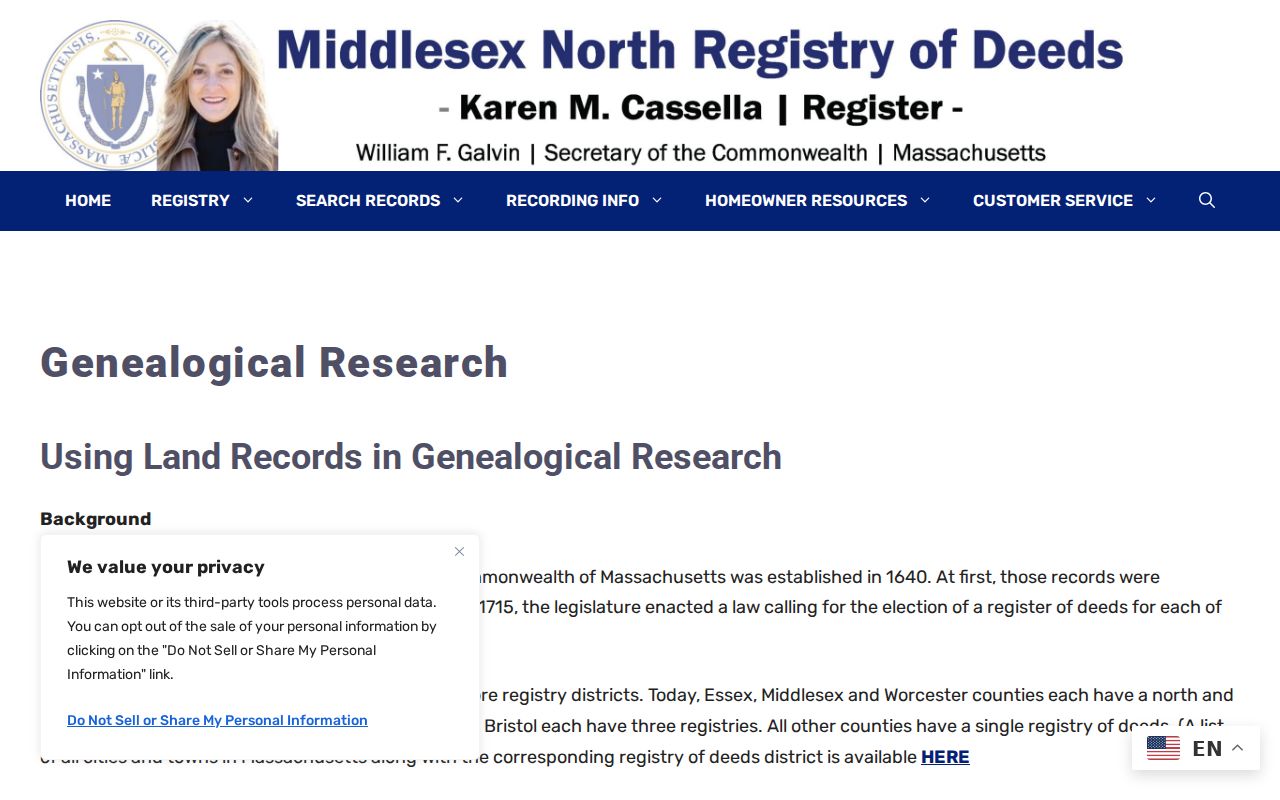
When one modern parcel carries several historical legal descriptions, preserve each plan and deed reference instead of forcing the older description into a modern street number.
Pair Wilmington Directories With Census Years
Property ownership is only one part of a prior-residents search. For household evidence, use the historical source closest to the date in question. Wilmington Memorial Library’s local-history collection includes the Wilmington History Index, town reports, maps, Town Crier files, persons-listed material, and related collections. Its digitized town reports cover displayed runs from 1829 through 2022. A report may identify an official, committee member, road reference, or other local mention, but it is not a complete household directory.
The flow is address or old label → directory or persons-listed entry → town report and local-history index → federal or state census for the matching era → deed or plan check. Federal census material is public through 1950 under the 72-year rule; Massachusetts Archives also identifies 1855 and 1865 state census resources. Save the year, page or line, source title, exact printed spelling, and whether the source calls someone an occupant, owner, official, or historical mention.
- Search the address, street variants, and person name in local history indexes, directories, town reports, and the historical society collection.
- Match the result to the nearest directory or list year rather than assuming an entry fills the years around it.
- Check the applicable census source for the same period, recording the page or line and the household context it actually displays.
- Return to the parcel, plan, and Registry chain to decide whether a printed address connects to the same property.
Detailed collection holdings and directory-reading methods belong on the Wilmington City Directory; the address trail should carry forward only the entries that help date a particular household.
Separate Wilmington Resident Records by Role
A past-household label is broad, but its evidence is narrow. An owner shown by Vision is a tax-record field. A grantee or grantor in a deed is a party to a recorded transfer. A person named in a 1931 directory is a printed historical entry. A town report can document an office, committee, road project, or other municipal role. None should be silently converted into a claim of present residence or continuous occupancy.
- Grantor and grantee
- The grantor transfers an interest in land; the grantee receives it. These terms describe the recorded transaction, not who occupied the address.
- Chain of title
- The documented sequence of recorded transfers that links one deed to an earlier deed through parties, book/page references, and legal descriptions.
- Legal description
- The parcel wording in an instrument, such as a lot, plan, or boundaries. It can be more reliable than a modern address for older research.
- Historical mention
- A dated reference in a report, index, newspaper, map, or collection. It must be labeled by the source’s actual context.
Use two independent sources when the identity question matters. A directory entry plus a town-report citation, or a parcel record plus a recorded deed, is stronger than one same-name result.
Record Gaps in Wilmington Resident Records
Gaps are normal in a Wilmington address history. The State Library’s verified directory holdings are sparse, older Registry pages can be image-only, and records can use former place labels. Do not interpolate a household between two dated entries. Instead, note the source searched, terms and spellings used, date range, result type, and what the record did or did not identify.
Vital, cemetery, obituary, and probate material can help close a historical trail, but each has its own limits. The Massachusetts Archives provides historical digital series, while the legal custodian controls certified copies. Olde Burying Ground material can provide names, dates, or inscriptions, but burial does not prove a person lived at the address at death. Probate may explain a transfer in a title chain, yet it should be cited as a probate record rather than treated as a deed.
Note: A negative search documents the portal and terms tested. It does not prove that a person never lived at the Wilmington address.
Keep Wilmington Resident Records Lawful
A dated house history can support family research, estate and heir work, local history, or personal property curiosity. It should not become a way to expose a protected address or track a living person. Massachusetts limits confidential voter information, restricted vital records, sealed and impounded court material, and Address Confidentiality Program records. If an official source withholds a field, preserve the gap rather than trying to reconstruct it from nearby records.
Wilmington public-records requests should identify the record, date range, department or custodian, preferred format, and requester contact. Massachusetts Public Records Law is M.G.L. c.66, §10, with exemptions principally in M.G.L. c.4, §7(26). A request can be redirected, redacted, or denied under an applicable rule, and that result belongs in the source chain.